Original Intelligent Optimization Algorithms
Transforming nature, human procedures, Taiwanese culture, organizational development, and multi-agent collaboration into computable, verifiable, and transferable optimization methods.
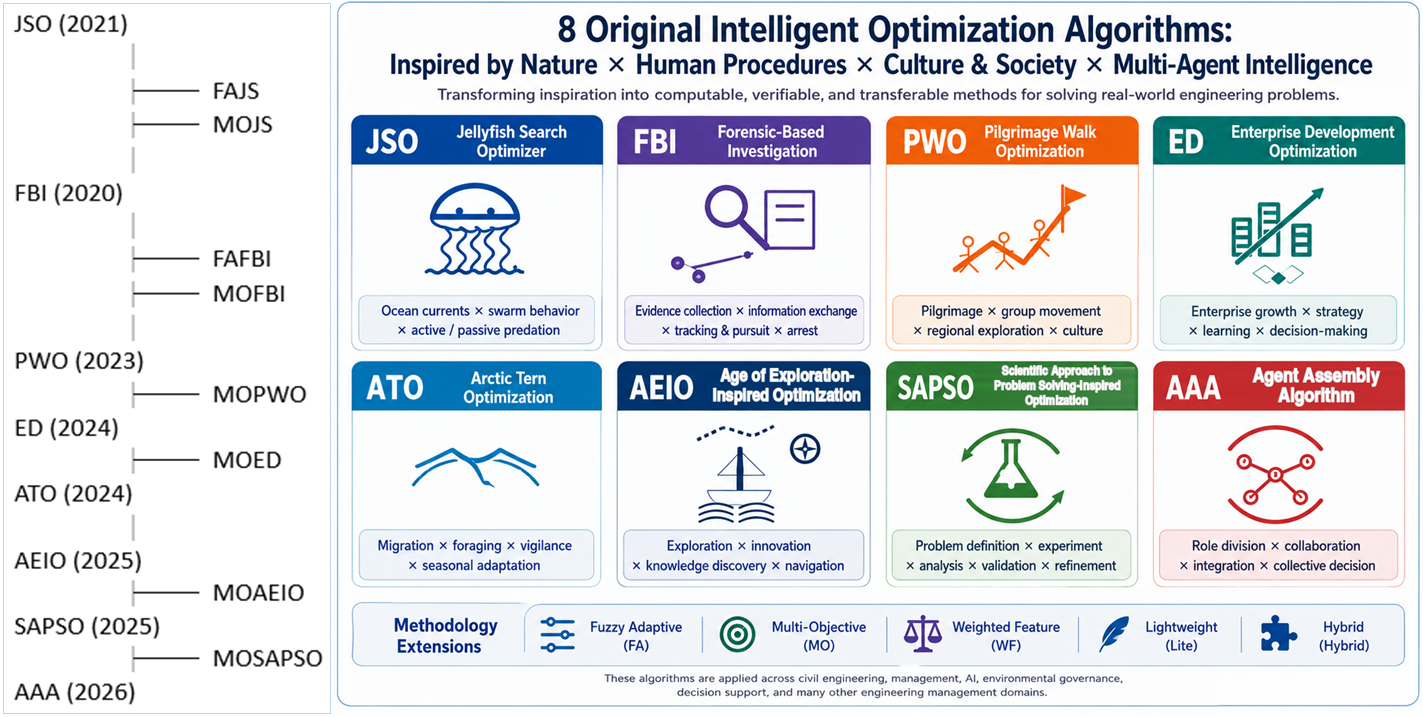
Eight Core Original Algorithms
FBI (2020) — Forensic-Based Investigation
Translates evidence collection, investigation, tracking, and pursuit into multi-group information exchange and solution-update mechanisms for guided exploration and exploitation.
JSO (2021) — Jellyfish Search Optimizer
Models ocean-current drift, swarm motion, and active/passive feeding through a time-control mechanism. JSO has achieved broad citation impact and open-source adoption.
PWO (2023) — Pilgrimage Walk Optimization
Inspired by Taiwan's Mazu pilgrimage, translating divination blocks, group movement, stopover rituals, crawling beneath the palanquin, and palanquin robbing into search operators.
ED (2024) — Enterprise Development Optimization
Models enterprise development from local operation and strategic cooperation to knowledge learning and international expansion, balancing competition, collaboration, and knowledge transfer.
ATO (2024) — Arctic Tern Optimization
Uses long-distance migration, navigation, foraging, vigilance, and seasonal return to coordinate global exploration, directional correction, and local development.
AEIO (2026) — Age of Exploration-Inspired Optimization
Translates unknown-region exploration, route correction, resource development, and accumulated experience into mechanisms for discovery and escape from local optima.
SAPSO (2025) — Scientific Approach to Problem Solving Optimization
Follows problem definition, hypothesis formation, experimental validation, evidence analysis, and knowledge revision to support iterative learning and evidence-based search.
AAA / A³ (2026) — Agent Assembly Algorithm
Models role division, hierarchical collaboration, opinion integration, and adaptive decision making among specialized agents to solve complex engineering and computational problems.
Adoption in International Software Packages
| Algorithm | First published | Third-party package inclusion | Lag |
|---|---|---|---|
| FBI | 2020 | Python mealpy, pyMetaheuristic, pyVolutionary | ~2 months |
| JSO | 2021 | R tourr (CRAN), Python pyMetaheuristic, Opytimizer, Otorchmizer, FEALPy | ~2 months |
| ED | 2024 | Python heurilab (PyPI v2.3.0) | ~2 years |
JSO in R CRAN
Added to the R package tourr in January 2024 and shipped with CRAN release 1.2.4 in February 2025 as the public function search_jellyfish(); evaluated in a dedicated study by UT Austin and Monash researchers in the Journal of Computational and Graphical Statistics (2026).
FBI in MEALPY
Independently implemented by the open-source community in June 2020 and included in MEALPY — the largest Python metaheuristic library (233 algorithms) — under the Human category as module FBIO, providing both the original and a third-party improved class.
ED in HeuriLab
Included in the Human/Social category from PyPI release v2.3.0 (29 July 2026), alongside classics such as TLBO, Jaya and Harmony Search. The library also ships a structural-novelty audit against 19 metaphor-free criteria.
Extensions by independent research groups
JSO family
More than 15 independent groups with no co-authorship ties have developed MJS, EJS, Bin_AJS, MOQRJFS and ONBJS variants, concentrated in energy and power systems.
FBI family
Professor Ali Kaveh's group developed the enhanced EFBI, published in Computers & Structures (2021) and as a Springer book chapter (2022); Modified FBI, Self-Adaptive FBI and Robust FBI followed from groups in Türkiye, Egypt and Vietnam.
ED family
Three independent groups released improved versions — MSEDO, LMEDO and CAED — within roughly a year of publication, in Scientific Reports and Biomimetics.
Verified August 2026 against each package's public source code and its PyPI/CRAN release record.
Methodological Extensions
Fuzzy Adaptive
Dynamic adjustment of exploration and exploitation according to search feedback, including FAJSO, FAFBI, and FAATO.
Multi-objective
Pareto-front construction, external archives, and leader selection in MOJS, MOFBI, MOPWO, MOED, MOAEIO, and MOSAPSO.
Hybrid and Application-Specific
Weighted features, machine/deep learning, lightweight designs, physical constraints, and MCDM for deployable engineering-intelligence systems.
Emerging Directions in 2026
Building on the established algorithm family, PiM Lab continues work on fuzzy-adaptive Arctic Tern optimization, collective-memory evolution, black-soldier-fly-inspired intelligence, agent collaboration, and multi-objective structural design. Published methods and work in progress are displayed separately to preserve an accurate cumulative record.